Wednesday, August 10, 2016

Hackers only do this because they find it so easy.
Australia Online Census Shutdown After Cyber Attacks
…   as thousands of people headed to the official website Tuesday evening, a series of denial-of-service attacks -- attempts to overwhelm an online system to prevent people accessing it -- prompted authorities to take the site offline.
"It was an attack, and we believe from overseas," said David Kalisch from the Australian Bureau of Statistics, which organises the census.
"The scale of the attack, it was quite clear it was malicious," he told the Australian Broadcasting Corporation.
The census website was not back online Wednesday.


There must be more here than I’m seeing.  If I was a conspiracy buff, I might see some serious hackers behind this.  What might North Korea want in exchange for not shutting down all airline systems? 
Complexity makes airline computer systems vulnerable
…   Why do these kinds of meltdowns keep happening?
The answer is that airlines depend on huge, overlapping and complex IT systems to do just about everything, from operating flights to handling ticketing, boarding, websites and mobile-phone apps.  And after years of rapid consolidation in the airline business, these computer systems may be a hodgepodge of parts of varying ages and from different merger partners.
These systems are also being worked harder, with new fees and options for passengers, and more transactions — Delta’s traffic has nearly doubled in the past decade.
…   It is unclear exactly what went wrong at Delta.  The airline said it suffered a power outage at an Atlanta installation around 2:30 a.m. EDT that caused many of its computer systems to fail.  But the local electric company, Georgia Power, said that it was not to blame and that the equipment failure was on Delta’s end.
IT experts questioned whether Delta’s network was adequately prepared for the inevitable breakdown.
“One piece of equipment going out shouldn’t cause this,” said Bill Curtis, chief scientist at software-analysis firm Cast. “It’s a bit shocking.”
Curtis said IT systems should be designed so that when a part fails, its functions automatically switch over to a backup, preferably in a different location.  “And if I had a multibillion-dollar business running on this, I would certainly want to have some kind of backup power,” he added.

(Related) I wonder if one of the vulnerabilities was, “turn off the power?” 
Joshua Philipp reports:
Computer systems of Delta Airlines have suffered a “glitch” that is causing flight delays on the airline globally.  While the cause of the delays is still unclear, a group of cyber criminals was recently selling vulnerabilities to major airlines on the black market.
On Jan. 3, cybercriminals on a darknet black market run by Chinese state hackers published an advertisement for information and vulnerabilities in a long list of major airlines that included Delta Airlines, United Airlines, Japan Airlines, FedEx, and others.
Read more on Epoch Times.

(Related)  How to backup an entire country?
Estonia's "Data Embassy" Could be UK's First Brexit Cyber Casualty
The government of Estonia is one of the most cyber-aware governments in the world.  Recent reports have suggested that the country has been in discussion with the UK for the establishment of an overseas data embassy.  Those same reports suggest that Britain's decision to leave the European Union is making Estonia reconsider the UK, and perhaps favor Luxembourg.  If this is true, it could make the loss of business with Estonia the first major cyber casualty of the Brexit.
…   Although the Ministry here describes the project as simply a data center, it has elsewhere used the term 'virtual data embassy'.  This is to differentiate the concept from simple backups that have been stored in overseas embassies for the last ten years.  Estonia is facing an issue now that will be faced by more and more nations as electronic government increases: secure mirrors will be required to ensure that the country itself doesn't face downtime in a catastrophe.  Estonia, of course faces the additional concern of physical incursion from its neighbor and one-time overlord, Russia.
Taavi Kotka, the Government CIO, wrote, "As part of this research project, we have evaluated methods to ensure that the data and services of and for our citizens, e-residents, and institutions are kept safe, secure, and continuously available.  Privacy, security, data protection, and data integrity are central to our government services."


A new (to me) resource!
What kind of month was July for breaches involving health information.  I counted 39 incidents reported during the month.  Read Protenus’s blog for an analysis of the incidents.
Update: Tom Sullivan of HealthcareITNews has a great write-up on the blog post.


I see a project for my Ethical Hacking students.
75 Percent of Bluetooth Smart Locks Can Be Hacked
Many Bluetooth Low Energy smart locks can be hacked and opened by unauthorized users, but their manufacturers seem to want to do nothing about it, a security researcher said yesterday (Aug. 6) at the DEF CON hacker conference here.


Something to amuse my Computer Security students.
25 Awesome “Bug Bounty” Programs for Earning Pocket Money
A bug bounty is a monetary payout for finding and reporting security holes in software.  If you have expertise in security protocols, you could make some extra pocket money hunting for bugs in popular apps and websites.
It’s also a great way to sharpen your skills and build your reputation as a security expert — to the point where you could be recruited by companies (or even the American government).  Here are the best bug bounty programs available in 2016.


Because the FBI has jurisdiction over all riots? 
Kristen V. Brown reports:
When the FBI sent secret spy planes to capture surveillance footage of the Baltimore protests of Freddie Gray’s death in 2015, the agency justified the aerial monitoring as necessary.  “Large scale demonstrations and protests” meant there was “potential for large scale violence and riots,” the agency wrote in an internal memo at the time.
Last week, the FBI released more than 18 hours of this footage in response to a FOIA request from the American Civil Liberties Union.  Captured by a thermal-imaging system with infrared cameras mounted to the plane’s wing, the footage was taken over five days during at least 10 surveillance flights.  The footage shows major Black Lives Matter marches, quiet neighborhood gatherings and near-empty streets.  It’s unclear if law enforcement acted on this footage in policing the protests.
Read more on Fusion.

(Related) Did the FIOA request ask about facial recognition?
Andrada Fiscutean reports:
Romania’s intelligence service is about to build a system to identify people taking part in street protests or talking on Facebook or Skype, according to four local human-rights groups.
In an open letter published on Monday, the groups said the system would be capable of running facial recognition on three million people.  It could also intercept online traffic without the consent of the users and will have unrestricted access to all public databases containing information about citizens.
Read more on ZDNet.


You know this is not going to die.  Ever.  (Translation:  When a politician says, “as far as I know” what he or she means is, “I’m staying deliberately ignorant, but I don’t want to admit that.” 
(Washington DC) – Judicial Watch today released 296 pages of State Department records, of which 44 email exchanges were not previously turned over to the State Department, bringing the known total to date to 171 of new Clinton emails (not part of the 55,000 pages of emails that Clinton turned over to the State Department).  These records further appear to contradict statements by Clinton that, “as far as she knew,” all of her government emails were turned over to the State Department


Is ad blocking the cyber-equivalent of muting the TV during commercials?
Facebook Will Force Advertising on Ad-Blocking Users
Facebook is going to start forcing ads to appear for all users of its desktop website, even if they use ad-blocking software.
The social network said on Tuesday that it will change the way advertising is loaded into its desktop website to make its ad units considerably more difficult for ad blockers to detect.  [Stealth ads?  Bob]


Interesting.  IT Architecture impacts brick and mortar architecture.  Surprising that delivery would be so different?
E-Commerce Forces Shift in Warehouse Building
The rise of online shopping is forcing warehouse builders to redraw the map of logistics hubs on the East Coast.


Politicians always feel virtuous when they can create a new “Sin Tax.”  Bet on it! 
State governments eye cash from fantasy sports
…   More than half of the nation’s state legislatures are set to debate measures to codify the existence of daily and weekly fantasy sports sites, which could provide a lucrative new revenue stream for cash-strapped governments.


Forsooth!
CU offering certificate in ‘Applied Shakespeare'
BOULDER - Valorous news!  Thee can anon receiveth a c'rtificate f'r studying the fine w'rks of the greatest playwright the w'rld hast ev'r seen.
The above sentence is an example of “Applied Shakespeare,” which, coincidentally, is also the name of the latest graduate certificate offered by the University of Colorado – Boulder.


You know this headline caught my eye.  (Beer!  There’s an App for that!) 
This smart glass earns you free beer


For the toolkit.  Not necessarily for my Ethical Hacking students. 
How to Take Remote Control of Someone Else’s PC


Also for the toolkit.  Organize your projects!
11 Trello Tips and Workflow Features for Programmers
Trello is one of the best productivity tools to hit the scene in the past decade, mainly due to the power of visual organization.  It’s more than just a to-do list alternative.  It’s an entirely different paradigm, especially for programmers.


For my students.  I wonder if there is an index of these fairs? 
Virtual Career Fairs: An Effective Recruiting Tool For The IC
…   One of the most popular questions I hear is, “Do these things [VCFs] work?  Do people really get hired from these events?” The answer is, unequivocally, YES.  I have worked with numerous students who have attended American Military University and American Public University’s National Security VCF in the past and have been hired due to the connections they made during the event.  While exact numbers can be hard to come by in the IC (for obvious reasons), the recruiters are returning again and again.
…   The IC hosts an annual VCF; the last one was in March 2016.  If the recruiters weren’t finding high-quality talent at VCFs then flat-out, they would not attend or host them.


I think I will re-arrange my priorities like Wally’s.

Tuesday, August 09, 2016

Hackers can swipe your swipe?
Data Breach At Oracle’s MICROS Point-of-Sale Division
A Russian organized cybercrime group known for hacking into banks and retailers appears to have breached hundreds of computer systems at software giant Oracle Corp., KrebsOnSecurity has learned.  More alarmingly, the attackers have compromised a customer support portal for companies using Oracle’s MICROS point-of-sale credit card payment systems.
…   MICROS is among the top three point-of-sale vendors globally. Oracle’s MICROS division sells point-of-sale systems used at more than 330,000 cash registers worldwide.


What’s a coffee addict to do?  (Never irritate your best customers!) 
Starbucks card glitches leave some customers steaming
Susan Gray, a teaching assistant in Royal Oak, Mich., was attempting to reload her Starbucks card on her phone’s Starbucks mobile app a few days ago when a message popped up saying, “We’re unable to process payment with the information given.”
Figuring there was something temporarily wrong, Gray tried to reload it again for $25 — unsuccessfully.  Despite four attempts, the $25 never showed up on her Starbucks account.  But she did get a call from her bank — which had flagged the transactions as possible fraud.
Gray is among an unknown number of Starbucks customers who are steaming over a days-old, still-unresolved tech glitch that’s left them unable to reload their Starbucks card, and in some cases, charged them for amounts that haven’t shown up on their Starbucks accounts.
…   The card is also tied to the company’s hugely successful mobile app, which customers can use to pay, or even to bypass lines by ordering and paying straight from their mobile phones.  In the most recent quarter, 25 percent of all transactions were conducted with the mobile app,


For my Computer Security students. 
EFF – How to: Avoid Phishing Attacks
by Sabrina I. Pacifici on Aug 8, 2016
EFF Surveillance Self Defense – “When an attacker sends an email or link that looks innocent, but is actually malicious, it’s called phishing.  Phishing attacks are a common way that users get infected with malware—programs that hide on your computer and can be used to remotely control it, steal information, or spy on you.  In a phishing email, the attacker may encourage you to click on or open a link or an attachment that may contain malware.  Phishing can also occur via Internet chat.  It’s important to double-check links that are sent to you via email or chat.  Web addresses in emails can be deceptive.  Web addresses in mail may appear to say one thing, but if you mouse over them to see where they really point, they might show another destination address…”


Just suspects?  What exactly is “questionable activity?” 
You knew this was coming, didn’t you?  Wendy Lee reports:
The Department of Homeland Security is hiring in Silicon Valley — for drones.
Last week, technology entrepreneurs filled a Menlo Park conference room, where officials spelled out their needs — drones small and light enough to launch easily and fly over vast stretches of desert.  The machines would look for questionable activity, scan faces of suspects and compare them against a database for prior criminal history.
Drones already operate along the border.  Eight large Predator drones, each with a 66-foot wingspan, help agents with monitoring.  Donald Trump, the Republican presidential nominee, told a Syracuse newspaper in April that he wanted to expand the use of drones at the border, in addition to the wall he wants to build.
Currently border drones do not use facial recognition technology, which remains controversial.
Read more on AllGov.


For my Data Management students.  Even  your best customers can get you in trouble.
AT&T fined $7.7M over illegal phone charges
The Federal Communications Commission fined AT&T more than $7 million on Monday for allowing scam artists with alleged links to the drug trade to illegally place charges on customers’ bills.
…   Federal authorities became aware of the scheme when the Drug Enforcement Agency learned that two companies suspected to be involved in money laundering and drug crimes were charging AT&T landline customers for directory assistance service that was never delivered.  Customers were charged roughly $9 each month, according to the commission.
Such scams, known as “cramming,” prey on the increasingly complicated nature of phone bills.


Well, doggle my boone.  Another government technology project wasting my tax dollars? 
The $47 Billion Network That’s Already Obsolete
The prize for the most wasteful post-9/11 initiative arguably should go to FirstNet—a whole new agency set up to provide a telecommunications system exclusively for firefighters, police, and other first responders.
…   FirstNet is in such disarray that 15 years after the problem it is supposed to solve was identified, it is years from completion—and it may never get completed at all.  According to the GAO, estimates of its cost range from $12 billion to $47 billion, even as advances in digital technology seem to have eliminated the need to spend any of it.


How valuable are a billion new users?
Express Wifi Is Facebook's Second Attempt To Bring Internet Access To Rural India
After the public debacle Facebook got into with the net-neutral Indian public with its 'Free Basics' program, Facebook hasn't given up.  Taking pointers from the raging debate about net neutrality that Free Basics set off in India, Mark Zuckerberg has decided to toe the line.
In its latest efforts to get more people from rural India on Facebook, the company has introduced Express Wi-Fi that will let smartphone users purchase data from local internet service providers.
Simply put, Facebook will now provide only the software that will help ISPs and entrepreneurs sell data in rural areas, that will be accessible using Wi-Fi hotspots.


If at first you don’t e-commerce, buy, buy again!
Wal-Mart CEO Doug McMillon on what he saw in Jet.com
Wal-Mart's acquisition of Jet.com was in some ways a return to basics for the world's largest retailer.
"If Wal-Mart were starting today and we were building an e-commerce business some of the things that Jet designed into their approach would have been things we would have thought of and we would have wanted to do, and they've just done it from scratch," Wal-Mart CEO Doug McMillon told CNBC's "Squawk Box."


This could be good or bad, but it will definitely be worth looking into!
White House software code-sharing policy goes live
…   The new Federal Source Code Policy also sets up a pilot program “that requires agencies, when commissioning new custom software, to release at least 20 percent of new custom-developed code as open source software (OSS) for three years,” Tony Scott, U.S. CIO and Anne E. Rung, chief acquisition officer, wrote in a memorandum to heads of departments and agencies on Monday.
…   Making source code available as OSS could also help federal software projects, because private users would implement the code and publish improvements, allowing for collaborative benefits such as software peer review and security testing, sharing of technical know-how and reuse of code, according to the memorandum.
…   The open source component of the new policy has its critics, who fear that the code could fall in the wrong hands and be misused.  In a post on Monday that tries to dispel myths around the use of open source, 18F wrote that there are several agencies that do classified work and release code that isn’t sensitive.  The National Security Agency has, for example, released code and documentation for its System Integrity Management Platform under an open source Apache license.  


For my Data Management students. 
New Gartner Magic Quadrant shakes up the file sharing world
The winners from this report would seem to be Box, Dropbox, Egnyte and Citrix Sharefile—all of which are (arguably) some of the earliest leaders in the space.


Thar’s gold in them thar job seekers. 
Job site Monster is being acquired by a Dutch recruiter for $429 million
Remember Monster.com? It was one of the first companies to harness the power of the internet to help connect jobseekers and potential employers.
It paved the way for the likes of LinkedIn and Glassdoor — as well as a new wave of snazzy job search apps, such as the so-called "tinder for jobs" Jobr (which it also acquired last month).
Now, Monster Worldwide has been snapped up by Dutch recruiter Randstad Holdings for $429m (£330.25m) in cash.


Just in case my students want to Photoshop something…
5 Awesome Adobe Apps That Are Completely Free
The company has recently been releasing several apps and programs for free.  And it has also turned some paid apps into free downloads, including the entire Creative Suite 2 (CS2) or Photoshop CS2 alone, and some of the best Android apps from 2015.

Monday, August 08, 2016

For my Computer Security students.  This does not read like a power outage.  Contrast this with the three levels of backup power sources that United Airlines reservation system uses.  Do you believe it was a simple “power outage?” 
Delta Air Lines passengers stranded after computer crash grounds flights
Delta Air Lines' computer systems crashed on Monday, leaving passengers of one of the world's largest carriers stranded at airports around the globe as flights were grounded.
The U.S. airline said the problems were down to a power outage in Atlanta overnight and that its information technology team was working to resolve the problem.
…   "Our systems are down everywhere.  Hopefully it won't be much longer," the airline said on Twitter earlier on Monday.
…   The glitch follows several high-profile computer problems faced by U.S. airlines in the past year.
They included budget carrier Southwest Airlines Co (LUV.N), which had to halt departures last month after a technical outage, while American Airlines (AAL.O) had to suspend flights from three of its hubs last September after technical problems.
Industry consultants say airlines face an increasing risk from computer disruptions as they automate more of their operations, distribute boarding passes on smartphones and fit their planes with Wifi.


An interesting group of “targets.”  Who do we know that would be interested in all of these? 
New spyware detected targeting firms in Russia, China: Symantec
A previously unknown group called "Strider" has been conducting cyber-espionage attacks against selected targets in Russia, China, Sweden, and Belgium, U.S.-based computer security firm Symantec Corp said on Monday.
The group, which has been active since at least October 2011 and could have links to a national intelligence agency, has been using an advanced piece of hidden malware identified by Symantec as Remsec (Backdoor.Remsec), the company said in a blog post.
Remsec spyware lives within an organization's network rather than being installed on individual computers, giving attackers complete control over infected machines, researchers said.  It enables keystroke logging and the theft of files and other data.
…   Remsec shares certain unusual coding similarities with another older piece of "nation state-grade" malware known as Flamer, or Flame, according to Symantec.
Flamer malware has been linked to Stuxnet, a military-grade computer virus alleged by security experts to have been used by the United States and Israel to attack Iran’s nuclear program late in the last decade (reut.rs/2b2FA8z).


A question for my Computer Security students.  It costs a lot to actively protect your users.  Is it worth it? 
Password Hacking Forces Big Tech Companies to Act
In the past few months, hackers have taken over the social-media accounts of Facebook Inc. Chief Executive Mark Zuckerberg, Google CEO Sundar Pichai and Twitter Inc. ’s CEO, Jack Dorsey.
Behind the scenes, security teams at every major technology company—and many smaller firms, too—are scrambling to protect others from the same fate.
…   Some of the executives apparently reused passwords that had been stolen in earlier hacks of LinkedIn, Myspace and other sites; others may have fallen victim to software that uses the old passwords to guess new ones.
Nearly two billion old passwords can be viewed for as little as $2 at a database called LeakedSource, run by anonymous operators.  Investigators estimate that maybe up to 8% of the LinkedIn usernames and passwords will work on other services, giving hackers a way to take over accounts elsewhere.  
…   Hacking creates a dilemma for operators of other popular consumer web services.  They can require all users to change their passwords, and risk losing some users.  If they don’t force password changes, users’ accounts could be hacked.
…   Twitter, Facebook, Yahoo Inc. and others chose a different course.  Instead of resetting all passwords, they analyzed the stolen credentials and then urged or forced affected users to reset their passwords.
…   Combing through the data is time-consuming.  Yahoo has one billion users.  Its security team began examining the LinkedIn database on May 18. Some of the account names and passwords were encrypted.  Yahoo staffers had to decode the names and passwords and look for matches with Yahoo’s users.  Eight days later, on May 26, Yahoo emailed notes out to an undisclosed number of affected users, telling them to reset their passwords.


If she had not named names, would tweeting about what she saw still be grounds for a lawsuit?  If the cleaning crew had posted pictures, would they (or the hospital) be liable? 
Law360 reports:
Allegations that a nurse at a major Chicago hospital tweeted about a shooting victim’s death and blood-soaked hospital room are a stunning cautionary tale that health care providers can use to hammer home how workers may be held liable for privacy lapses, attorneys say.
A Chicago nurse allegedly tweeted this image of a patient’s room, prompting a lawsuit.  The allegations surfaced in a new lawsuit accusing Karrie Anne Runtz, a trauma nurse at Mount Sinai Hospital, of “recklessly and outrageously” tweeting about the April 2015 death…
Read more on Law360 (subscription required).


Dean Wormer’s “Double Secret Probation” bleeds into Big Brother’s world? 
Paper – Coming to Terms with Secret Law
by Sabrina I. Pacifici on Aug 7, 2016
Rudesill, Dakota S., Coming to Terms with Secret Law (November 01, 2015). 7 Harvard National Security Journal 241 (2015); Ohio State Public Law Working Paper No. 321.  Available for download at SSRN: http://ssrn.com/abstract=2687223
“The allegation that the U.S. government is producing secret law has become increasingly common.  This article evaluates this claim, examining the available evidence in all three federal branches.  In particular, Congress’s governance of national security programs via classified addenda to legislative reports is here given the first focused scholarly treatment, including empirical analysis that shows references in Public Law to these classified documents spiking in recent years.  Having determined that the secret law allegation is well founded in all three branches, the article argues that secret law is importantly different from secrecy generally: the constitutional norm against secret law is stronger than the constitutional norm against secret fact.  Three normative options are constructed and compared: live with secret law as it exists, abolish it, or reform it.  The article concludes by proposing rules of the road for governing secret law, starting with the cardinal rule of public law’s supremacy over secret law.  Other principles and proposals posited here include an Anti-Kafka Principle (no criminal secret law), public notification of secret law’s creation, presumptive sunset and publication dates, and plurality of review within the government (including internal Executive Branch review, availability of all secret law to Congress, and presumptive access by a cadre of senior non-partisan lawyers in all three branches).”


Sounds like a poor choice to me.  Why not call an Ambulance?  If he had passed out, pulling to the side of the road would not have improved his odds of survival.  A new meme for this blog, “Technology helps those who help themselves!”  
A Missouri man might owe his life to his Tesla Model X's Autopilot
…   In late July, Joshua Neally left work and began to drive home in his week-old Tesla Model X, activating the Autopilot feature when he entered the highway.  Miles down the road, he felt "the most excruciating pain [he’s] ever had," in his chest, and after calling his wife, decided to go to the nearest emergency room.  Neally allowed the car to continue driving on the highway for the next twenty miles, before taking over and guiding the vehicle the remaining couple of miles to the hospital, where he checked himself into the emergency room.
Neally noted that he probably should have simply called an ambulance, and potentially could have put other drivers at risk by continuing to drive.
…   For his part, Neally noted that he trusted the car to help, saying that if he had fallen unconscious, it would have steered to the side of the road.


Perspective. 
‘Pokémon Go’ has eclipsed $200 million in total revenue one month after launching
…   App analytics platform Sensor Tower released the worldwide revenue data on Friday, citing its latest “Store Intelligence” information. The company also published a chart comparing Pokémon Go’s financial success to that of other previous top earners, including Candy Crush Soda Saga and Clash Royale.
…   As seen above, Pokémon Go was only slightly outperforming Clash Royale for the first 18 days following its launch, but that was before Niantic Inc. released the app in Japan, Nintendo’s home country, where the biggest Pokéfans likely reside.  Revenue exploded from there, spiking from around $75 million to $200 million in just under 14 days.


A geezer’s perspective?  I have not noticed a big difference in my students.
Survey upends concept that older workers averse and stressed by using technology
by Sabrina I. Pacifici on Aug 7, 2016
Via CIO: “Cloud storage provider Dropbox and Ipsos Mori, a London-based market research firm, surveyed more than 4,000 information workers in the U.S. and Europe about their use of technology in the workplace and found that people 55 and up use 4.9 forms of technology per week, on average — a smidge above the overall average of 4.7 per week.  More importantly, the survey also revealed that older workers are less likely than their younger colleagues to find using technology in the workplace stressful.  Just one-quarter of the respondents who are 55 or older said that they find tech in the workplace stressful.  Meanwhile, 36 percent of the respondents who are 18 to 34 years old — the ones who supposedly grew up with technology — said they find tech in the workplace stressful.”


Historical perspective.
World's First Public Website Went Online 25 Years Ago
…   Believe it or not, the first webpage ever put online is still online, and at the exact same address: http://info.cern.ch/hypertext/WWW/TheProject.html.


Ah Hulkster, you’ve got them down.  Now hit them with the chair!  On the other hand, you have to try to get something! 
Gawker and Hulk Hogan Said to Be in Settlement Talks Over Privacy Case
According to a Wall Street Journal report.
Gawker Media Group is engaged in preliminary talks with the former professional wrestler Hulk Hogan to reach a settlement over a $140 million court judgment that led the company to file for bankruptcy protection, the Wall Street Journal reported on Sunday.
The settlement talks come a week ahead of a court-administered auction that will see Gawker Chief Executive Nick Denton lose control of the company, the Journal said.


For my students.
Why my fellow students aren’t interested in doing data science for you
…   The statistics (perhaps ironically) are pretty convincing. Summarized in an article at Datanami, McKinsey says that by 2018, the demand for data scientists will outpace supply by 60%.  Accenture noted that 90% of its clients were looking for data talent, and 40% cited a lack of it as a major problem.  And to top it off, Glassdoor found that the median starting salary for a data scientist can be almost double that of a programmer.  Everybody’s looking to hire and pay (well) for data people, but they can’t seem to find them.

Sunday, August 07, 2016

Looking for soldiers that could be recruited into ISIS?
Helsinki Times reports:
The Finnish Defence Forces’ accusations that researchers have leaked the results of psychological tests conducted on hundreds of thousands of conscripts are exceptional, estimates Reijo Aarnio, the Data Protection Ombudsman of Finland.
[…]
The scope of the alleged data leak is very unusual, if not outright unprecedented, says Aarnio.  “But you’re talking about an exceptional case when you take into consideration the kind of information [that was allegedly leaked],” he says in an interview with Uusi Suomi.
Read more on Helsinki Times.


Ever more popular, think of all the ways this can injure a firm.
The Hindu reports:
A diagnostic centre in the national Capital was recently targeted by unknown hackers, who through a ransomware gained illegal access to its servers and encrypted the data.
They demanded ransom from the owner in the form of bitcoins to restore the data.
[…]
Based on a complaint from the diagnostic centre, the Central Bureau of Investigation has registered a case under Section 384 (punishment for extortion) of the Indian Penal Code and Section 66 (computer related offences) read with Section 43 (damages and compensation for the offence) of the Information Technology Act.
Read more on The Hindu


This is why I have my Computer Security students read and analyze articles on recent breaches.
F5 Networks: It’s time to rethink security architecture
F5 Networks held its annual industry analyst conference this week within its user conference, Agility in Chicago.  One of the main messages F5 tried to get across to its customer base is that it’s time to rethink security.
I agree with that thesis wholeheartedly, and it is consistent with many of the posts I have written in the past year, including one I wrote about defining the new rules of security in a digital world.
F5 had several interesting supporting data points that show businesses are investing their security dollars in the wrong places.  F5’s director of systems engineering, Gary Newe, pointed out that 90 percent of security budget is focused on the network perimeter, although only 25 percent of the attacks are focused on that point in the network.  Juxtapose that with the fact that 72 percent of attacks now are aimed at the user identity and applications—and only 10 percent of security budget is used for that—and it’s easy to see why F5 is telling its customers their security strategy needs to change.
…   Today the world is entirely different.  Workers are mobile, applications are in the cloud, and we’re connecting billions of devices to our networks.  Newe gave an example of a typical worker today who could spend his or her day using applications such as Salesforce.com, Office 365, Dropbox, Concur and Service Now.  It’s possible for a worker to spend the entire day working on applications that are not behind the company firewall.  This has been the trend for a while, yet businesses spend billions annually on firewalls.  Security teams now need to protect dozens, maybe hundreds or even thousands, of entry points, but the bad guys need to merely find one way in.

(Related)
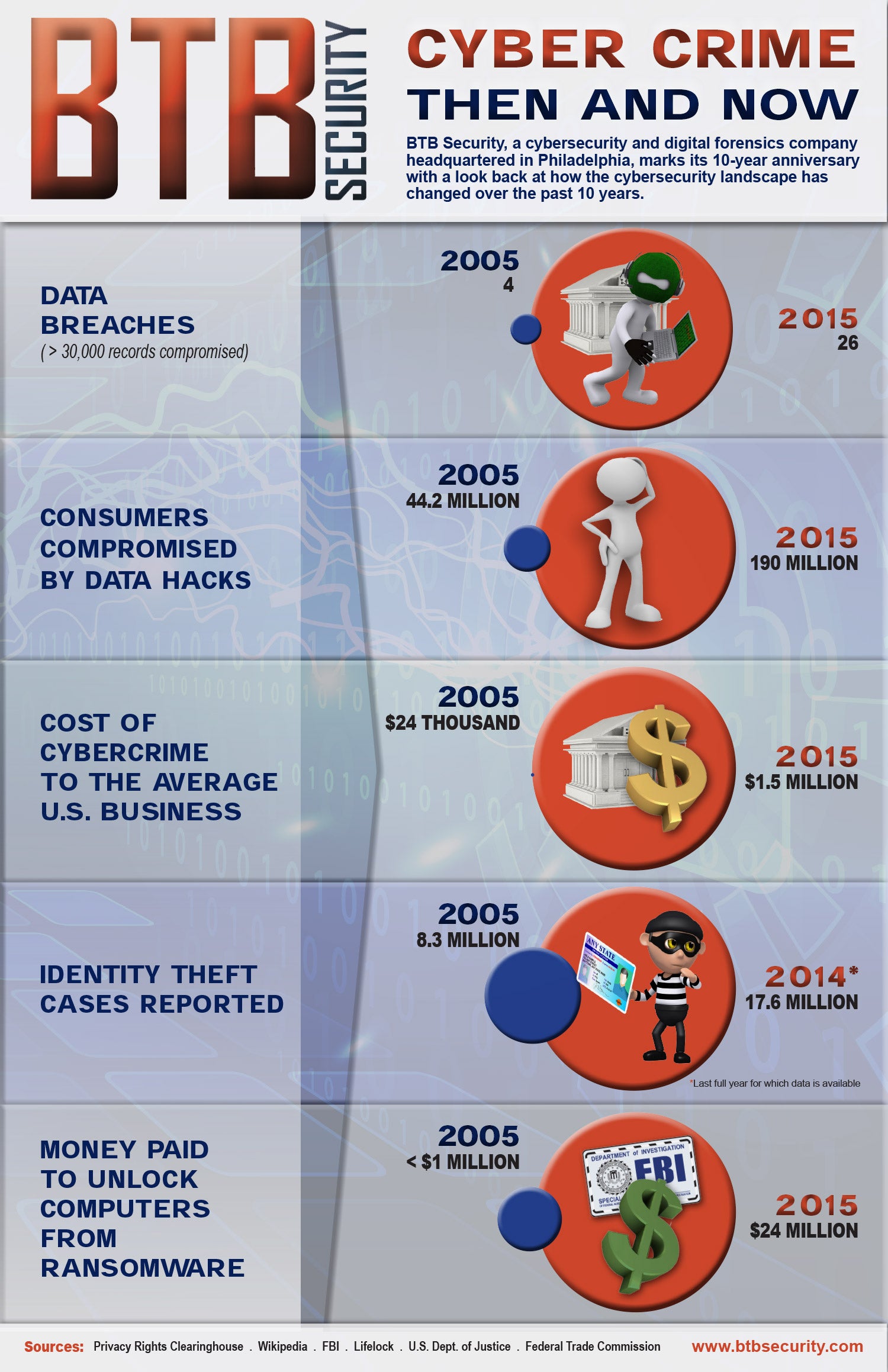
How Cybercrime Has Changed (Infographic)


I’ll ask my Computer Security students to design a much more secure system for poor old Chrysler. 
Houston Car Hackers Suspected Of Theft of More than 100 SUVs and Trucks
Houston police have arrested two men for a string of high-tech thefts of trucks and SUVs in the Houston area.  The Houston Chronicle reports that Michael Armando Arce and Jesse Irvin Zelaya were charged on August 4th, and are believed to be responsible for more than 100 auto thefts.  Police said Arce and Zelaya were shuttling the stolen vehicles across the Mexican border.
…   The July video shows the thief connecting a laptop to the Jeep before driving away in it.  A Fiat-Chrysler spokesman told ABC News that the thieves used software intended to be used by dealers and locksmiths to reprogram the vehicle’s keyless entry and ignition system.


A new record, but probably not for long.  (Is $1.39 per person adequate?) 
I’ve had a lot of coverage of Advocate Health’s breaches over the past years that you can access here.  Here’s is HHS’s announcement of the settlement of their charges:
Advocate Health Care Network (Advocate) has agreed to a settlement with the U.S. Department of Health and Human Services, Office for Civil Rights (OCR), for multiple potential violations of the Health Insurance Portability and Accountability Act (HIPAA) involving electronic protected health information (ePHI).  Advocate has agreed to pay a settlement amount of $5.55 million and adopt a corrective action plan.  This significant settlement, the largest to-date against a single entity, is a result of the extent and duration of the alleged noncompliance (dating back to the inception of the Security Rule in some instances), the involvement of the State Attorney General in a corresponding investigation, and the large number of individuals whose information was affected by Advocate, one of the largest health systems in the country.
…   OCR began its investigation in 2013, when Advocate submitted three breach notification reports pertaining to separate and distinct incidents involving its subsidiary, Advocate Medical Group (“AMG”).  The combined breaches affected the ePHI of approximately 4 million individuals.


Pay for privacy!  What a great business model.
Dan Seitz reports:
There’s no privacy on the internet.  Facebook will only begrudgingly let you talk privately with your friends, the government wants to look at your browsing history without a warrant, and Comcast looks at every piece of data you transmit over the internet to learn more about you.  But the cable company will stop, if you pay them for the privilege.
Comcast is trying to make this change because the FCC is considering new rules that would force internet service providers to disclose all the information they collect and sell.  Comcast wants to be able to charge users who’d rather not be spied on by a large company not well-known for its people skills, which they argue is a perfectly acceptable business practice.
Read more on Uproxx


No more drinking beer in private!
Ron Brown reports:
Alabama wants to know who’s buying beer from it’s craft breweries and taking it home to drink…but industry groups say it’s an invasion of privacy.
The Alabama Alcoholic Beverage Control Board wants to require brewers to collect the name, address, age and phone number from anyone who purchases beer at a brewery.
Read more on Rivet.
[From the article:
The Control Board hasn't publicly explained WHY it wants to collect detailed information...the new rule will be considered in September.


Taking another shot a “harm?”
Natalie Garcia and Charles W. Mondora write:
Two class actions currently pending in the United States Court of Appeals for the Third Circuit, In re Horizon Healthcare Services Inc. Data Breach Litigation (D. N.J. Mar. 31, 2015), appeal docketed, No. 15-2309, and Storm v. Paytime, 90 F.Supp. 3d 359 (M.D. Pa. 2015), appeal docketed, No. 15-3690, are being monitored closely by cybersecurity attorneys and their corporate clients.  In both of these data-breach cases, the plaintiffs are appealing the district court’s dismissal of their respective complaints because the district courts found that the plaintiffs lack Article III standing and suffered no injury-in-fact, relying heavily upon Reilly v. Ceridian Corp., 664 F.3d 38 (3d Cir. 2011), the controlling Third Circuit precedent.
Read more on New Jersey Law Journal.


Are we so naïve that we are fooled into thinking that Peyton Manning eats nothing but Papa John’s pizza?
FTC to Crack Down on Paid Celebrity Posts That Aren’t Clear Ads
…   This uptick in celebrities peddling brand messages on their personal accounts, light on explicit disclosure, has not gone unnoticed by the U.S. government.
…   This means more cases like the one against Warner Bros. Home Entertainment Inc., which last month settled with the FTC over charges that it deceived customers by paying internet influencers such as PewDiePie – who has about 50 million followers on YouTube -- to promote the video game Middle-Earth: Shadow of Mordor with positive reviews, without disclosing that they were paid and told how to promote it.  In March, the FTC issued a complaint against Lord & Taylor for paying fashion influencers to create posts about one of its dresses on Instagram, without disclosing that the retailer paid them and gave them the dresses for free.  Any compensation, including free products, should be disclosed, the FTC says. [Just so you know, I’d be happy to endorse free beer.  Bob] 


Useful?
PrepFactory - Free SAT & ACT Prep Activities
As autumn approaches many high school students in the United States will turn their attention to college applications and the SAT or ACT exams.  Some students' parents will spend lots of money on test prep materials and or tutors.  But students don't have to spend money to access excellent SAT and ACT preparation materials.
PrepFactory is a free service that offers excellent SAT and ACT preparation activities.  The site offers free guides to SAT and ACT strategy along with a plenty of review activities to help students sharpen their skills and knowledge before taking the ACT or SAT.  
…   One of the better ways to prepare for a test is to review small chunks frequently.  PrepFactory provides students with a good review system that breaks SAT and ACT review into bite-sized modules for each of the topics on the tests; each module contains a 3-5 minute video, notes on the video, and a five question video review quiz.

Saturday, August 06, 2016

One of the downside risks of “pushing” updates? 
PoS Trojan Bypasses Account Control Posing as Microsoft App
A newly discovered PoS (Point-of-Sale) malware can bypass computer defenses such as User Account Control (UAC) by posing as a legitimate Microsoft application, Doctor Web researchers have discovered.
…   Upon infection, the Trojan performs a series of checks to determine whether on the targeted system runs any program that could hinder its activity.  It looks for any copies of itself, as well as for virtual machines, emulators, and debuggers, and terminates itself if any of these is found.
Otherwise, the malware runs itself and attempts to gain administrator privileges by tricking the default system defenses.  In the User Account Control (UAC) warning triggered by the malware, however, the user is informed that the running application is called WMI Commandline Utility (wmic.exe) and is developed by Microsoft.


My Computer Security students should find this confusing. 
Insurers working to fill cyberinsurance data gaps
Insurance companies typically have decades of data, if not more, on which to base their risk estimates.
That's not the case with cyber risk, however.  There's very little historical data available, the data is not complete, and the threat landscape doesn't just change year by year, but day by day.  There isn't even a standard set of definitions that everyone can agree on.
…   One of the first problems when it comes to buying cyberinsurance is that nobody knows exactly what it means.  Corporate financial officers, security managers, and insurance brokers have different understanding of risk, for example.


According to a recent cyberinsurance survey by the SANS Institute, only 30 percent of underwriters and 38 percent of information security professionals believe that they speak the same language.  
…   For example, one policy might refer to a "privacy breach," another to a "data breach", and a third to "network security wrongful acts."
"Is a privacy breach the same thing as a privacy wrongful act?" he asked.  "Is a data breach the same as a network security wrongful act?"
"And a lot of the language hasn't been tested in court yet," he added.
…   In a recent survey the company conducted, only 10 percent of IT experts said they believed that their cyber coverage was completely up to date, and of those who had cyber insurance, and only 43 percent were confident that it covered business email compromise fraud.  There was a similar lack of confidence about new social engineering attacks.
"Almost half -- 45 percent -- of firms are clueless as to whether their cyberinsurance policy is up to date for covering these types of threats," Malone said.


“We use that code to identify our VIP passengers, not for security.” 
Hacker uses fake boarding pass to get into every airline lounge for free
…   The security flaw was discovered by Przemek Jaroszewski, the head of Poland’s Computer Emergency Response Team.  He discovered that lounge access is coded into the QR code of an electronic boarding pass, but not verified by any central database.
…   The hack hasn’t been tested in North America, so it’s possible that it would be defeated by more stringent checks.  The TSA told Wired that lounge security is the responsibility of the airlines, and is nothing to do with the more general security apparatus.


Another form of intimidation?  Actions short of war? 
Cyber Espionage Targets Interests in South China Sea
A cyber espionage campaign has been discovered apparently targeting participants in the recent Permanent Court of Arbitration case brought by the Philippines against China over Chinese claims of sovereignty in the South China Sea.
…   The cyber espionage campaign was discovered by F-Secure.  It named it NanHaiShu, and has today published an analysis of the methodology and malware involved.   
…   One thing is certain -- Chinese feelings in the South China Sea run deep.  Soon after after the ruling it commenced a major wargames exercise with, according to ZeroHedge, "some 300 ships, dozens of fighter planes, and involved troops that are responsible for coastal defense radars, communications, and electronic warfare defense."


Are we about to retaliate? 
Obama prepares to boost U.S. military's cyber role: sources
…   Under the plan being considered at the White House, the officials said, U.S. Cyber Command would become what the military calls a "unified command" equal to combat branches of the military such as the Central and Pacific Commands.
Cyber Command would be separated from the National Security Agency, a spy agency responsible for electronic eavesdropping, the officials said.  That would give Cyber Command leaders a larger voice in arguing for the use of both offensive and defensive cyber tools in future conflicts.


Perspective.  If Pokémon is eating batteries, what Apps are neglected? 
Pokémon Go drives a surge in smartphone backup battery sales
Early on in the Pokémon Go hype cycle, there were signs that players were driving a significant uptick in sales of backup batteries, like the Mophie units you may be familiar with that offer USB connections for topping up mobile devices while you’re away from an outlet.  Now, research from analytics firm NPD Group goes beyond early anecdotal evidence to show that in fact, unit sales across the portable power pack segment saw a 101 percent spike in the two weeks spanning July 10 and July 23, as compared to the same period last year.


Another week older but no wiser.
Hack Education Weekly News
…   Denver District Judge Michael Martinez has ordered a halt to a Douglas County program that allowed parents to use vouchers to send their children to private schools.
…   “Atlanta Public Schools debut new police force,” WSB-TV reports.  Every school will have a dedicated police force, which as Tressie McMillan Cottom quips, is more than have AP classes.
…   Also via Inside Higher Ed: “A prominent technology think tank wants the federal government to encourage the use of standardized assessments to measure postsecondary knowledge and skills, with an approach that would separate learning from credentialing and challenge the dominance of traditional college degrees.”

Friday, August 05, 2016

Update.  It takes a while to unravel the knots these hackers tied. 
Philippine central bank fines Rizal Bank over Bangladesh cyber heist failings
The Philippine central bank said on Friday it would fine Rizal Commercial Banking Corp (RCB.PS) (RCBC) a record 1 billion pesos ($21 million), after the bank was used by cyber criminals to channel $81 million stolen from Bangladesh Bank in February.
The central bank said in a statement that it was the largest amount it has ever approved "as part of its supervisory enforcement actions" on a bank.
…   Unknown hackers tried to steal nearly $1 billion from the Bangladesh central bank's account at the Federal Reserve Bank of New York between Feb. 4 and Feb. 5, and succeeded in transferring $81 million to four accounts at RCBC in Manila.
RCBC earlier on Friday challenged Bangladesh Bank to take it to court, telling Reuters that the "Philippine side has done its part" and that the transfers were made based on authenticated instructions over payments network SWIFT.
…   A Bangladesh central bank team is currently in Manila to try and recover some of the lost money, but said they were close to getting back only $15 million.


Somehow, I don’t think this will be received well.
Users of hacked bitcoin exchange may be forced to share loss
Hong Kong-based bitcoin exchange Bitfinex is likely to spread the $68 million loss from Tuesday’s cyber-theft among its clients.  This may include users who weren’t directly affected by the hack.
“We are still working out the details so nothing is set in stone, however we are leaning towards a socialized loss scenario among bitcoin balances and active loans to BTCUSD positions,” a spokesperson of the exchange posted on Reddit.


Niche investing?  Are the local versions of global Apps really worth this much? 
KKR, Warburg Pincus Invest in Indonesia Motorcycle-Hailing App Go-Jek
Investors including KKR & Co. and Warburg Pincus LLC reached a deal Thursday to invest more than $550 million in Indonesian motorcycle-hailing app PT Go-Jek, according to a person familiar with the situation.
…   Go-Jek offers cheap, on-demand motorcycle taxis that can be booked through smartphones.  The company’s fixed prices and pickup times meaning passengers don’t need to haggle over prices at motorbike stands.  It has also expanded into on-demand grocery shopping, delivery services, masseuses and beauticians, and has also ventured into offering cars and minivans.

(Related)  Clones without a niche?  Full on competition?
Startups Seek to Challenge Craigslist in Online Classifieds
An arms race is heating up to replace Craigslist, the dominant force in online classifieds the past two decades.
Startup companies OfferUp and Letgo are surging in popularity among people looking to buy and sell everything from used clothes to used cars through their smartphones.  And deep-pocketed investors are paying up for stakes in them even though they don’t charge for their services today.


Perspective.  Think of this as another indication that Big Data is really, really big!
Can Twitter Fit Inside the Library of Congress?
In 2010, the Library of Congress and Twitter announced a historic and incongruous partnership: Together, they would archive and preserve every tweet ever posted, creating a massive store of short-form thoughts.  It was odd: a 210-year-old institution partnering with a four-year-old startup, cataloging the internet’s ephemeral #brunchtweets.
…   Yet, however dubious the task seemed back then, no one doubted the Library of Congress would get the work done.  If Twitter could handle a few million tweets a day, surely the largest library in the world could, too.
But as it turns out, it couldn’t.
…   The library has been handed a Gordian knot, an engineering, cyber, and policy challenge that grows bigger and more complicated every day—about 500 million tweets a day more complicated.  Will the library finally untie it—or give in and cut the thing off?
“This is a warning as we start dealing with big data—we have to be careful what we sign up for,” said Michael Zimmer, a professor at the University of Wisconsin-Milwaukee who has written on the library’s efforts.  “When libraries didn’t have the resources to digitize books, only a company the size of Google was able to put the money and the bodies into it.  And that might be where the Library of Congress is stuck.”


For the student tool kit.
How to Quickly Scan Documents Using Android & Google Drive
…   Get started by opening the Google Drive app on your Android phone.  Tap the floating + button in the bottom-right corner and choose Scan.  The app will launch your camera and you can snap a photo of whatever you’d like to scan.


For my students and my peers.
…   If you think of social media as the sole province of vacation selfies and muffin recipes, the idea of using it for genuine professional development may seem absurd.  But there are plenty of ways you can use social media to build professional skills, knowledge, and relationships, without getting overwhelmed.
To get real learning value out of social media, ask yourself these three questions:
What do I want to learn?
When do I have time for learning?
Whom do I want to learn from or with?